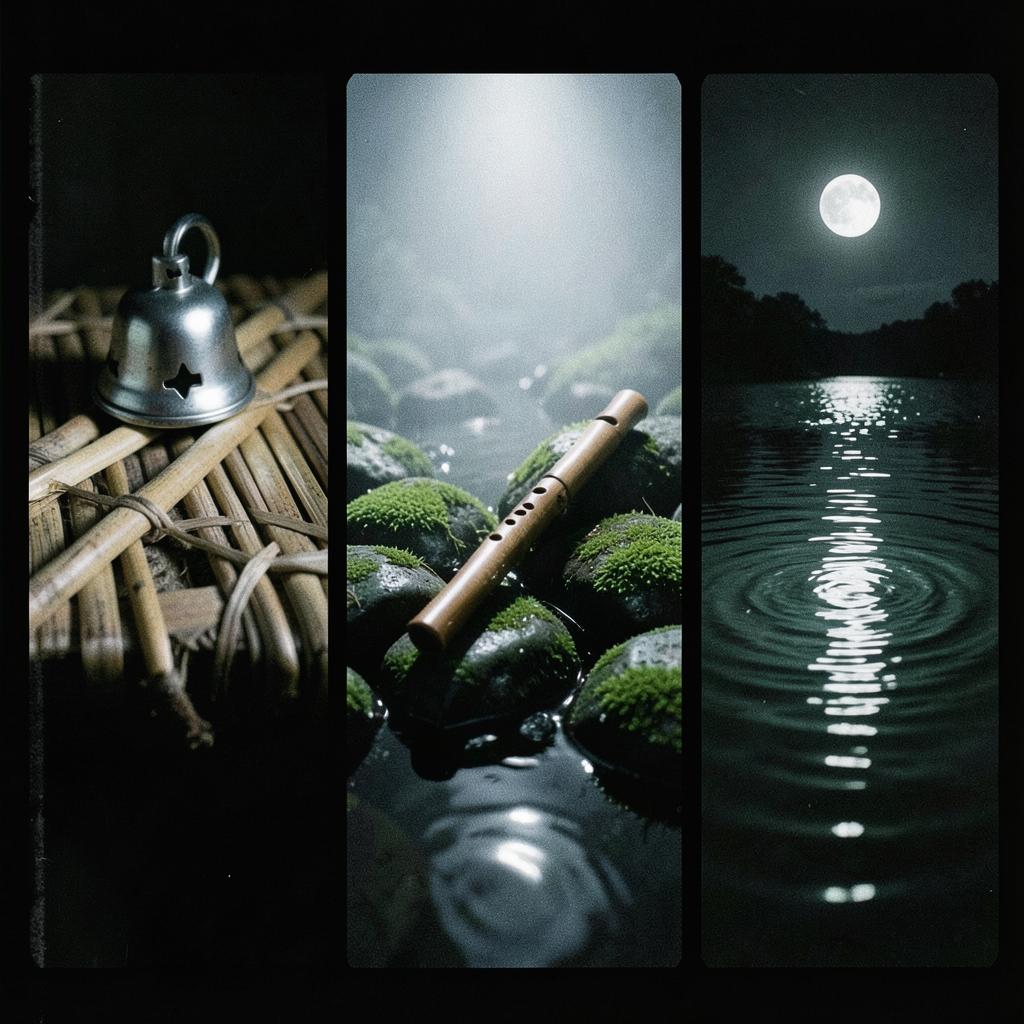
One work a day, from first sound to final decay. Ninety verified complete masters rotate on a stable UTC calendar—without a popularity chart, personal tracking or pretending that today's turn is a new release.
Sun, August 23, 2026CYCLE DAY 88 / 91 · UTC
TODAY'S COMPLETE RECORDING · 3:27Silver Bells to the Ganges银铃到恒河
TODAY'S COMPLETE RECORDING · 3:27
Silver Bells to the Ganges
银铃到恒河
‘The hulusi asks the bamboo grove; the bansuri answers deep in the night.’ Instead of melting two voices into vague exotic colour, the song lets them hear one another across distance and turns that distance into a complete quiet ballad.
WHY THIS WORK STAYS · BEYOND THE ARTWORK
Hear it whole first. Then read why it remains.
01 · THIRTY CONTEMPORARY POSITIONS, ZERO BORROWED VERSE
All thirty lines from bamboo house to Ganges are contemporary; place is imagined distance, not fabricated experience
The public source prompt contains forty-seven lines, thirty-nine nonblank, 387 characters and 873 UTF-8 bytes, hashing to 5de60d6b88b4cc4e9942586c2ce691c71b9e9d28f34efb6fa8e530b7eee8b0b7. Removing structure labels and blanks leaves thirty performed lines, 272 characters and 758 UTF-8 bytes, hashing to 003543456a9d8e59c5d866082247b2b57dc7ad7efd147c5fef3c8347866d9906. No classical verse, traditional folk lyric or identifiable received text is borrowed. 银铃到恒河 occurs four times; 一路月色一路歌, 我用很轻的声音, 唱过万水千山的沉默 and 一颗心还为你热 each return twice to form the refrain. Bamboo house, Ganges, mountains, rivers and south wind create an imagined geography of distance. The page does not recast that geography as the writer’s travelled route, a documented transborder romance, pilgrimage testimony, Indian religious narrative or living Dai social history.
02 · LET THE INSTRUMENTS ANSWER, NOT IMPERSONATE
‘Hulusi asks, bansuri answers’ matters more than exotic stacking; dialogue preserves difference and generation limits
The 244-character source tag string frames ‘Dai folk meets gentle Bollywood slow ballad’ as an arrangement direction: delicate ethnic female vocal, hulusi and bansuri duet, soft tabla, sitar touches, warm strings, moonlit borderland love song and slow 6/8 sway, with no rap, EDM or big drums. It hashes to bdaac4eb77e2572a28beca86d70b805a61dfd3cac6a5f031c8cb95226a65e688. The creative move is not to claim that two traditions have become one sound, but to write ‘the hulusi asks the bamboo grove; the bansuri answers deep in the night’. The Metropolitan Museum’s instrument records help preserve basic categories: its collection includes a late-nineteenth-century Indian bamboo transverse flute, while its organology describes the sitar as a leading plucked instrument of North Indian Hindustani music. None of that proves that this recording contains physical instruments, human players or a specific lineage. The archive records generation cues only; it does not certify human hulusi / bansuri / tabla / sitar performance or let virtual Dai Amei speak for Dai, Indian, Ganges-basin or Bollywood practitioners.
SEVEN-DAY WINDOW · COMPLETE SONGS ONLY
Three days either side. Every ending intact.
These dates are not release dates; they are shared listening coordinates. Open any day and the Chinese and English editions land on the same verified master.
UTC · 91-DAY STABLE ROTATION · NO PERSONAL TRACKING
Not a chart. A daily promise to hear one work properly.
The rotation claims neither hottest, best nor newest, stores no personal taste profile and never recounts a work because it appears under another dated URL. The same stable order returns after ninety-one days.
PASS ONE COMPLETE SONG ON
Hear Dai Amei’s Silver Bells to the Ganges in full: a 3:27 contemporary Mandarin original with complete MP3 and full vertical source-lyric film. All thirty performed positions are contemporary writing. Hulusi, bansuri, tabla and sitar remain cross-cultural generation directions—not claims of human performance, travel documentation, ethnography or community authorization.
Today's Complete Listen|Silver Bells to the Ganges|Weiyang Sound