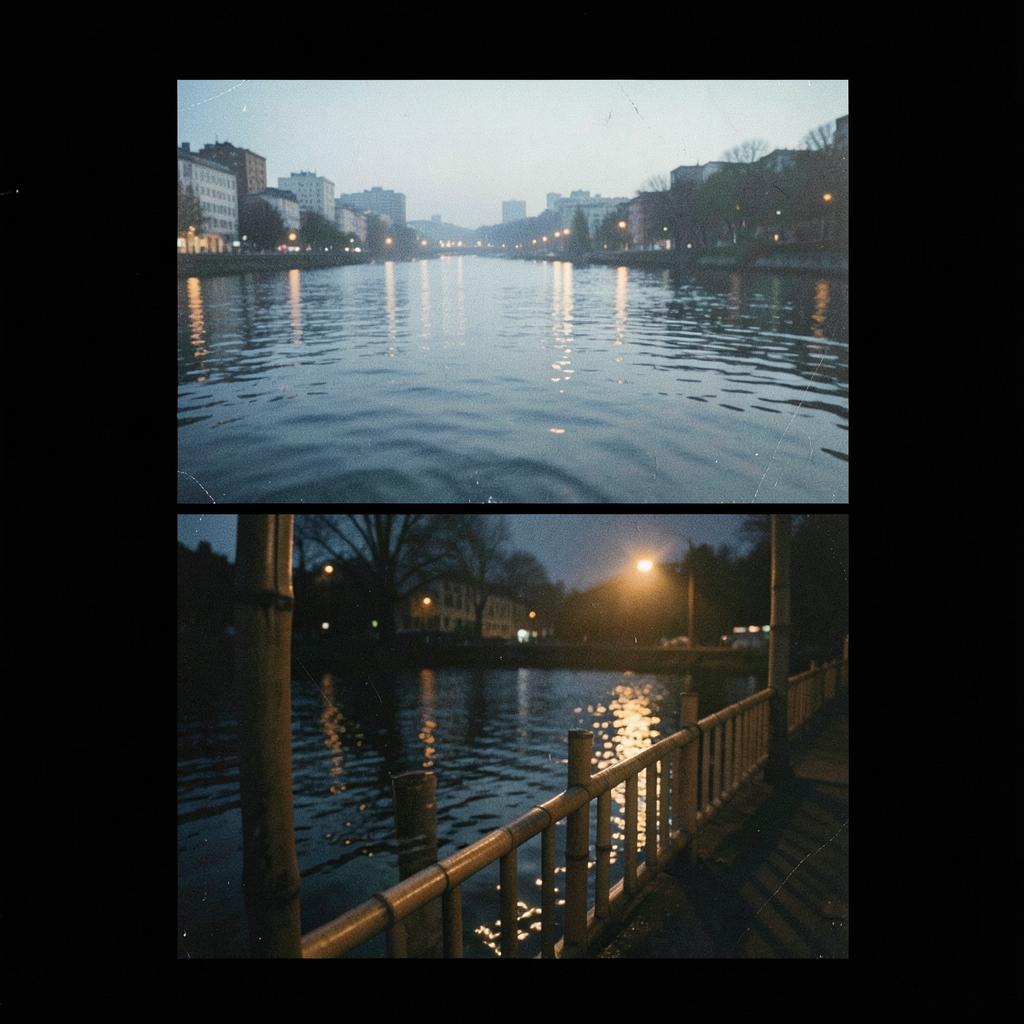
Hear the Water before Assigning a Style
Cross-cultural music can become beautiful very quickly. Add a flute, a distant place name and unfamiliar colour, and the world appears to have met inside one song. But when the result is only the atmosphere of somewhere else, culture has been compressed into a filter. The more ordinary question must come first: what does this river do inside the character?
Water is not scenery in these five works. It returns a commuter toward an inward home, gives unreachable distance a shared route and lets unlike instruments answer across a bank. Once the river carries emotion and narrative, style has a reason to enter. Without that work, even rich instrumentation is only a well-lit travel window.
Clear Water River: Homecoming Can Begin before the Map
Clear Water River begins among commuters, an urban channel and photographs stored on a phone, then moves toward a moonlit bamboo house. It never presents home as a certified real location. It follows a contemporary person searching through exhaustion for an inward direction that can still be called home.
Dai Amei carries that route without speaking for a living Dai community. She is a registered Weiyang Sound virtual singer whose clear, folk-inflected register can move city noise away and bring waterside space close. A singer identity may accumulate across works; cultural authority does not arrive automatically with a name.
Moon over the Mekong: A Real River Name Adds Responsibility
The Mekong is a real transborder river, which gives its use more responsibility than an invented name. The song borrows it for distance, moonlight and the other bank. A Lao greeting and regional colour do not establish a reconstruction of Dai, Lao or Thai musical tradition. The more factual the place name, the more disciplined the editorial framing must become.
I hear the song as an imagination of shared water: one moon meets several banks, and a Mandarin slow song becomes an invitation to notice that a river never obeys one cultural label. The work can open a route for further listening and learning without folding a complex region into three convenient words: Southeast Asian style.
By the Peacock River: An Invented Place Need Not Pretend to Be Fieldwork
Peacock River exists inside its song. Peacock, starlight, water and an old fence gradually build it. All thirty performed positions are contemporary writing, with no borrowed classical poem or received folk lyric. Calling it imagined geography does not dim the scene; it gives the listener honest permission to enter.
If that invention were marketed as travel experience, ethnic fieldwork or the source of a traditional song, it would acquire only false authority. AI can generate persuasive landscapes and cover images, making human disclosure more important: this is a created world, not documentary evidence. Imagination may travel far; facts should not drift behind it.
Let the Hulusi Ask and the Bansuri Answer
The decisive move in Silver Bells to the Ganges is not the number of named instruments. It is a relationship: ‘The hulusi asks the bamboo grove; the bansuri answers deep in the night.’ Question and answer keep two voices from melting into generic exotic colour. They acknowledge distance before sharing a phrase.
The source tags place hulusi, bansuri, tabla, sitar and a slow 6/8 sway inside a generation brief. The archive records exactly that evidence and does not certify human performance, traditional repertory, travel documentation, ethnography or community authorization. Precise instrument names cannot be used to substitute for a performance history that does not exist.
Let the Moon Rest on Your Shoulder: Intimacy Can Cross Distance
Dai Amei leads the first four works; Breathy Female leads the fifth. That casting change matters because a cross-cultural route should not forever depend on one singer with a regional name. Breathy Female draws the generation directions—bansuri, tabla, tanpura, sitar and Hindustani ornament—into close-mic distance until large geography comes to rest on one shoulder.
‘Not every passionate love must be shouted into the centre of the world’ is also a circulation decision. Cultural encounter need not prove itself through bigger drums and denser symbols. Breath, restraint and a slow sway can bring unfamiliar sound close. Intimacy does not reduce the world; it lets the world arrive at a scale an ordinary listener may follow to the final note.
Virtual Singers Are Continuing Characters, Not Cultural Proxies
Dai Amei and Breathy Female belong to Weiyang Sound's lead virtual cast. They have recurring registers, narrative distances and scenes they can carry, and their earlier works travel with them into later recordings. Treating them as characters makes casting more serious; it does not grant them permission to speak for real populations.
The boundary also protects the singers from becoming filters. Dai Amei need not remain trapped inside ‘ethnic style’; Breathy Female is more than a whisper effect. A character can change arrangement, geography and story while remaining recognizable. Living traditions remain with living people and communities, while virtual creation becomes freer by naming its actual position.
An Arrangement Should Behave Like Confluence, Not a Souvenir Table
Collage asks what was put into the track. Confluence asks how the elements changed one another. An instrument that appears for two seconds to announce a regional style is a souvenir. An instrument that changes breath, pulse, melodic reply and the singer's distance has entered the composition.
I therefore ask whether hulusi and bansuri actually answer, whether percussion enlarges the song or protects its sway, whether strings overwhelm the close voice and whether a second chorus means something new because of the earlier encounter. More elements do not make a larger world. A few sounds in a real relationship can open enormous space.
Place, Instrument and Translation Names Are Both Signposts and Guardrails
Cross-cultural work must be searchable and shareable, but also correctly named. Mekong, Ganges, hulusi, bansuri, tabla, sitar and tanpura are not interchangeable. English titles should help an unfamiliar listener enter without rewriting a work's factual identity for convenience. Accurate terms allow circulation to travel farther with fewer false recognitions.
Names alone are not understanding. The pages still need to say that Clear Water and Peacock River are imagined lyrical geographies, while Mekong and Ganges are real names used creatively; listed instruments come from generation prompts rather than verified players. Translation opens the door and carries the boundary through it.
Generated Moonlight Can Be Beautiful without Becoming Documentary
The complete vertical films and covers preserve water, moons, bamboo lattice, a silver bell, wind instruments and distant views. Together they form a clear visual grammar and help the listener remember each work. None of those images proves a real location, garment, object date, ritual context, photographer or the life of a living community.
I want to retain the creative power of generated images and place their evidence level in public view. Art does not weaken when it says ‘not documentary’. Once viewers know they are entering an intentionally designed music world, beauty is less likely to be mistaken for fact and imagination for authorization.
Every River Route Must Reach Its Ending
Cross-cultural music is especially easy to reduce to fifteen seconds: one unfamiliar instrument, one place name and one reversible hook can stop a feed. That first encounter proves only that an entrance works. It cannot prove a complete emotional arc or show whether unlike sounds remain related through the second verse, bridge and ending.
The listening map below therefore holds five complete MP3 masters, five full dossiers and one continuous queue—not five trailers. A listener can move from the urban edge of Clear Water to the Ganges, then return through a moonlit tributary to one shoulder. Circulation makes the invitation; complete playback keeps the promise.
A Real Bridge Lets Both Banks Continue to Exist
I want Weiyang Sound to become a home for Chinese and Western cultural encounter, not a machine that blends world styles into one global sound. The more durable direction lets the patience of Chinese slow-song storytelling, instrument imagination from different regions, virtual voices and global listeners meet while admitting that they begin on different banks.
A bridge does not prove difference has disappeared. It gives people a reason to approach. Someone may remember one moon, then look up the bansuri; someone may love a Chinese phrase before discovering how many cultures live along one river. When the work does not appropriate or erase, and still earns a complete listen, cross-cultural music becomes more than decoration. It becomes a continuing practice of hearing one another.
What this essay is grounded in
This essay is grounded in five verified complete Weiyang Sound works—Clear Water River, Moon over the Mekong, By the Peacock River, Silver Bells to the Ganges and Let the Moon Rest on Your Shoulder. Each has complete MP3, full vertical source-lyric or source-prompt film, bilingual recording dossier and exact Suno work evidence. All five use contemporary original lyrics. Dai Amei and Breathy Female are virtual singers; instruments and regional styles are described only at the level supported by source generation directions. Clear Water and Peacock River remain imagined lyrical geographies. Real place names, generated imagery and cultural influence are not presented as travel documentation, ethnography, reconstructed tradition, human performance, community authorization or documentary evidence.