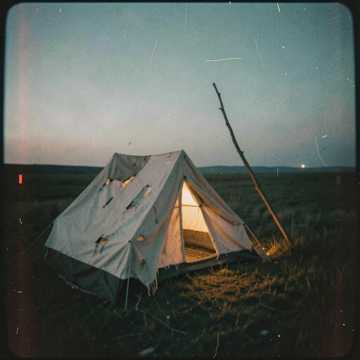
猎人提醒远方陌生且有危险,叙述者仍想背起帐篷越过天边。歌词里的回应不是要求对方负责自己的路,而是表达自己的意愿。同组《Beyond the Edge of Sky》有相同角色与叙事走向,原词措辞和段落不同,作为相关版本保留。
原词为英文,传统韩国民乐与叙事民谣的编曲方向,让伽倻琴琶音、大笒与觱篥应答、柔和杖鼓和克制盘索里式表达进入歌中。可以先追随叙事再听句尾转折,不把韩式配器误标成韩语演唱,也不把歌词中的冒险当作出行建议。
展开歌词
[Verse 1]
A far-off campfire fades, then rises bright,
Across the plain, the people sleep at night.
I wander through the wilderness and trees,
No country lanes, no rooster on the breeze.
I saw a hunter climb the mountain lone,
The wind brings rain; the dark will soon be known.
Why not pitch one small tent and wait for dawn?
The great sun sinks, then climbs the sky again.
[Verse 2]
The hunter says farewell and walks afar,
Beyond my sight, still moving like a star.
He goes a long way, then he turns around,
This time he looks toward where I stand aground.
But he is far; I cannot read his eyes.
[Chorus]
The sudden wind comes rushing over me,
And then I hear his words across the lea:
The distant world is stranger than before,
Yet danger waits in every pass and door.
Please do not follow me,
For I will not lead you.
[Verse 3]
I have one battered tent, worn thin and torn;
I only want to take it down and roam.
If I should follow you,
Believe me, I need no hand to guide me.
I’ll shoulder up my tent and cross the edge,
Beyond the farthest rim of earth and sky,
Even if I cannot see your form.
[Chorus]
If I should follow you,
Believe me, I need no hand to guide me.
I’ll shoulder up my tent and cross the edge,
Beyond the farthest rim of earth and sky,
Even if I cannot see your form.